

Make a donation
Banff National Park topographic map
Click on the map to display elevation.
Make a donation
Banff National Park
Banff National Park has a subarctic climate with three ecoregions, including montane, subalpine, and alpine. The forests are dominated by Lodgepole pine at lower elevations and Engelmann spruce in higher ones below the treeline, above which is primarily rocks and ice. Mammal species such as the grizzly bear, cougar, wolverine, elk, bighorn sheep and moose are found, along with hundreds of bird species. Reptiles and amphibians are also found but only a limited number of species have been recorded. The mountains are formed from sedimentary rocks which were pushed east over newer rock strata, between 80 and 55 million years ago. Over the past few million years, glaciers have at times covered most of the park, but today are found only on the mountain slopes though they include the Columbia Icefield, the largest uninterrupted glacial mass in the Rockies. Erosion from water and ice have carved the mountains into their current shapes.
Make a donation
About this map
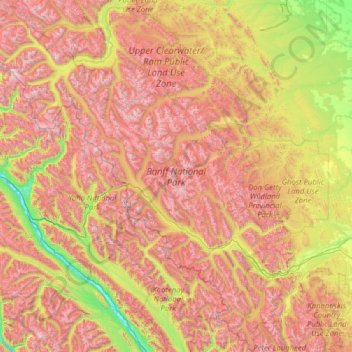
Name: Banff National Park topographic map, elevation, terrain.
Location: Banff National Park, Alberta, Canada (50.70506 -117.31712 52.27145 -115.16491)
Average elevation: 1,848 m
Minimum elevation: 773 m
Maximum elevation: 3,472 m
Make a donation
Other topographic maps
Click on a map to view its topography, its elevation and its terrain.

Make a donation


Make a donation
Canmore
Elevation Place opened in April 2013 as Canmore's new recreation facility. Construction of the facility began in 2012 to replace the Canmore Recreation Centre (the community's old facility). The facility offers an 8-lane 25m lap pool, a world class climbing wall developed by Walltopia, two cardio rooms, a…
Average elevation: 1,565 m
Make a donation